



_jpg.png)
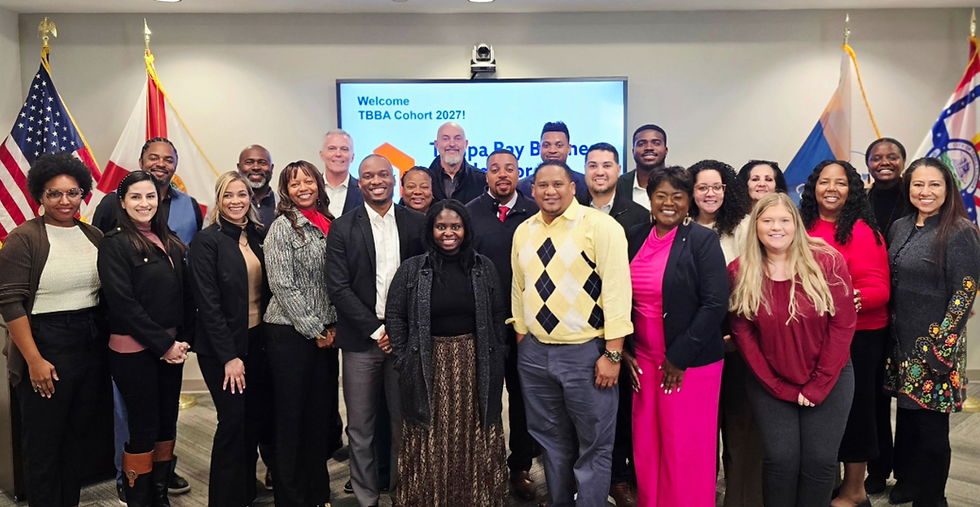
In 2017, the Tampa Bay Chamber of Commerce launched a business accelerator to address a sobering reality - a widening revenue gap for disadvantaged companies. The organization has since evolved into a powerhouse.
Statistics underscore the Tampa Bay Business Accelerator’s (TBBA) regional impact. The diversity-focused nonprofit has served over 60 nascent companies, which have generated more than $131 million in revenue.
Formerly known as the Minority Business Accelerator, the free, two-year program is proving that the most effective way to strengthen Tampa Bay’s economy is through a structured system of collaborative mentorship. Dr. Meaza Stewart-Morrison, director of economic inclusion at the chamber, measures success by the number of entrepreneurs who “no longer have to navigate growth alone.”
“We knew that no single organization could solve every challenge facing a growing business,” Stewart-Morrison said. “But together, our community could create something much more powerful.”
That philosophy of community-led growth remains TBBA’s true north. Stakeholders realized that minority-owned businesses were an integral part of the region’s economy, but “generated a disproportionately small share of overall business growth,” Stewart-Morrison said.
The goal was to create a holistic, ongoing ecosystem of support rather than “just helping individual businesses grow,” she added. TBBA’s executive committee and board of directors now reads like a veritable who's-who of local corporate, civic, academic, and entrepreneurial leaders.

Selected participants undergo immersive training in financial engineering, high-stakes contract negotiation, and operational scaling, while simultaneously gaining direct access to elite circles of regional decision-makers and industry consultants. By eliminating barriers and bridging the divide between grassroots enterprises and expansion capital, the program acts as a regional pipeline for job creation and sustainable wealth.
“By helping entrepreneurs overcome disparities, remove barriers, and gain access to relationships, resources, and opportunities they need to scale, we’re building an economy that works for everyone,” Stewart-Morrison explained. “Growing businesses create quality jobs, purchase goods and services from other local companies, become suppliers for larger corporations, and reinvest in the neighborhoods where they live and work.”
Eight cohorts have graduated from the accelerator. The current 13-member class, the largest yet, will conclude next year. TBBA is currently accepting applications for its next cohort.
Participants have secured over $12 million in capital and created more than 1,000 jobs. Those metrics highlight how the right community, mentors, and technical assistance partners can provide access to opportunities that “once felt out of reach,” Stewart-Morrison said.
She noted that participating businesses represent a wide range of industries and vary dramatically in size and age. All are at a “pivotal point in their journey,” Stewart-Morrison added, and seek “strategic guidance, relationships, and resources that will help them scale to the next level.”
“What’s been especially rewarding is seeing the community grow alongside them,” she continued. “Many alumni continue giving back as mentors, speakers, Leadership Council members, and connectors for future cohorts.”

The program dropped “minority” from its moniker in 2025. However, the shift was a mission statement meant to scale community support rather than a marketing pivot.
Including the term “Tampa Bay” casts a wide, regional net while reinforcing that “this work belongs to all of us,” Stewart-Morrison said. “We also realized that the best way to increase the diversity of voices, perspectives, and opportunities was to pull more seats to the table.”
“By welcoming more partners, more expertise, and more champions for small businesses, we’ve created a community where entrepreneurs have greater access to the people and resources that can help them grow,” she concluded.
Those efforts continue paying dividends. Recent success stories include an alumna who entered the accelerator with a $1.2 million small business and now operates a $12 million company.
Stewart-Morrison also noted that three participants cut ceremonial ribbons for new buildings in the past year. Expansions create jobs, enhance commercial corridors, and build confidence in Tampa Bay’s economy, she said.
The most glaring signal of TBBA’s impact, however, is not found in a spreadsheet. Stewart-Morrison emphasized that “relationships are what make the numbers possible.”
“What began as an accelerator has evolved into a community of business leaders who continue investing in one another long after graduation,” she said. “That ripple effect is exactly what we hoped to create.”
To apply for the upcoming Tampa Bay Business Accelerator cohort, visit the website here.