


_jpg.png)
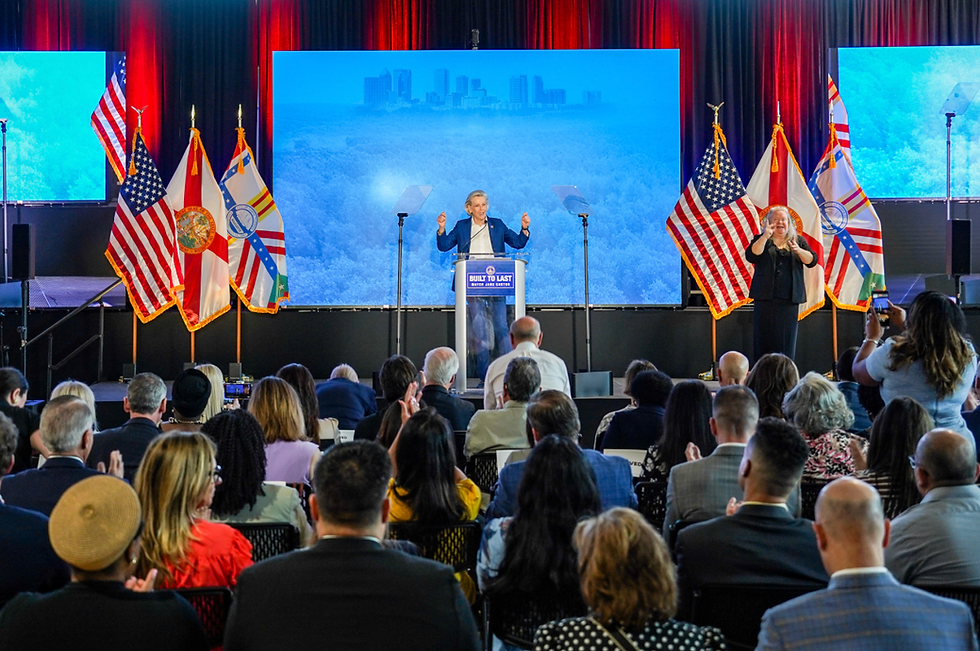
Mayor Jane Castor chose a unique venue for her seventh, and likely last, State of the City address - a sparkling new community center in underserved East Tampa.
Castor told attendees who packed the Fair Oaks Community Center on Tuesday that the centerpiece of a $34.7 million project completed in December represented the city’s ongoing efforts to invest in its residents. She called the 33,055-square-foot facility “a promise delivered.”
The event’s theme was “Built to Last,” and Castor, whose second and final term ends on May 1, 2027, highlighted the progress she has made toward achieving that goal. She credited investments in infrastructure, housing, and, perhaps most importantly, people, for the city’s success.
“What we are building is not temporary,” Castor said. “It is built to last, built for our residents, built for our neighborhoods, built for the future of this city, because the story of Tampa has always been a story of people who believe in this city and work together to make it stronger.”
The center, part of the new 10.25-acre East Tampa Recreation Complex, in the heart of a community redevelopment area, featured prominently at the event. Students from nearby Potter Elementary School recited the Pledge of Allegiance.

Castor noted that East Tampa is rich with history, culture, and talent, yet municipal officials overlooked the area for far too long. She said the new complex, a “regional jewel in our park system,” embodies a commitment to “investing in the people and places that built this city.”
“When cities invest in neighborhoods, something powerful happens,” Castor continued. “Families want to live nearby, businesses want to open up, neighborhood pride grows, and opportunity follows.”
After assuming office in 2019, the former police chief set an ambitious goal to create 10,000 affordable housing units. Over 8,300 have been completed or are underway.
A “beautiful mixed-income community” in East Tampa, a reimagined Robles Park, will soon provide 2,000 additional homes. Castor said the city has dedicated $100 million to affordable developments and housing assistance since 2019, as the region’s population and living costs spiked.
Tampa has approved nearly $22 billion in construction permits since Castor took office, including 23,000 new market-rate housing units. However, she is particularly proud of investing in programs that offer East Tampa residents housing rehabilitation and down payment assistance, and foster homeownership opportunities.
Castor said Tampa’s growth “isn’t just about buildings.” The goal is to ensure residents can stay, work, and improve their lives in the city.
“Tampa’s strength has always come from the people who take a chance; who open up a business, create something new, and invest in our community,” Castor said. “That’s especially true for our small businesses. They create jobs, they support families, they bring life to our neighborhoods.”

Port Tampa Bay now generates a $34.6 billion annual economic impact and supports over 192,000 jobs. Tampa International Airport is undergoing a “world-class expansion” and boasts more non-stop flights than ever before, Castor added.
Building a city to last starts with the basics, Castor said, and water mains were breaking almost daily when she assumed office. The city has since spent over $3 billion replacing functionally obsolete pipes in “one of the largest investments in Tampa’s history.”
The city has also replaced 78 miles of aging water lines and rehabilitated 210 miles of wastewater piping, all while ensuring utility rates remain among the region’s lowest, Castor said. “These upgrades have prevented leaks, reduced sink holes, conserved water, improved reliability, and protected against costly failures.”
Castor noted that Tampa is building the world’s largest Suspended Ion Exchange water treatment facility to remove “forever chemicals.” In addition to improving water quality, the technology will save taxpayers over $2 million annually by reducing the need for chemical treatments, she said.
The city is moving forward with the final piece of its South Tampa stormwater system, along South Howard Avenue, Castor announced. While it would be “far easier to shelve that project for years of additional studies and delays,” she said, flooding does not “wait for a consensus.”
Tampa has paved 310 miles of streets, repaired 100 miles of sidewalks, and added 56 miles of bike lanes since 2019, Castor said. The city is also expanding its free TECO Streetcar service, now a “vital transportation option” connecting downtown, the Channel District, and Ybor City.
Castor also expressed excitement for the new Tampa Bay Ferry. She said regional stakeholders have committed to making the service, which will offer lower fares and exponentially more trips than its predecessor, a “real option for commuters in the Bay Area.”
“We are going to keep investing, keep building, keep moving forward, because this isn’t about one moment,” Castor concluded. “We are honoring our past, we are embracing our future, and together, we are building the greatest Tampa yet.”

Share Your News with Us
To share news with the Power Broker, connect with reachout@powerbrokermagazine.com. To sign up for our twice-weekly e-newsletter, visit www.powerbrokernews.com; and to join our online conversation, subscribe to our YouTube channel at Power Broker Media Group – YouTube