


_jpg.png)

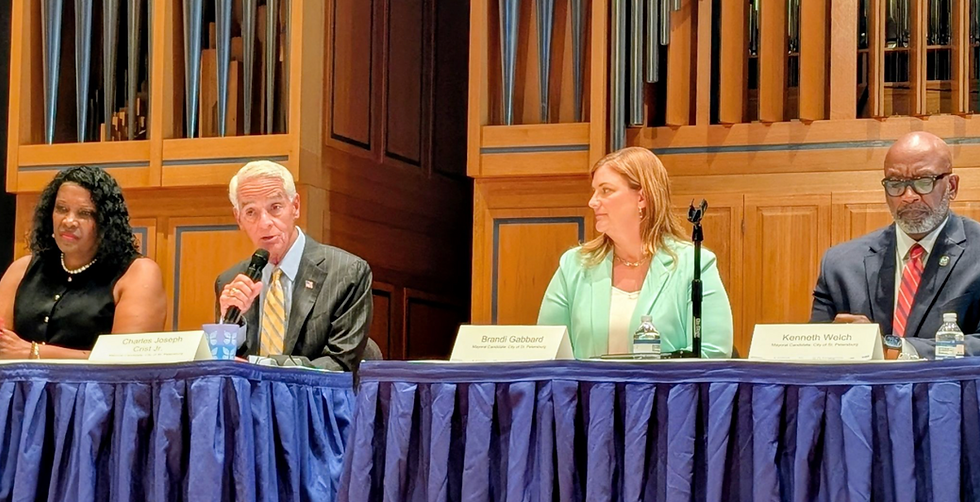
All six St. Petersburg mayoral candidates shared a stage for the first time on Thursday evening. The forum’s format forced them to focus on policy rather than trading barbs, which they did in abundance at last week’s debate.
The event, hosted by the League of Women Voters at the St. Petersburg College Gibbs Campus, also featured another notable difference from the first debate, hosted by the NAACP: former Fire Chief Jim Large participated. Approximately 270 people attended the substantive forum and over 150 watched online as Mayor Ken Welch, two-term City Councilmember Brandi Gabbard, former NAACP President Maria Scruggs, businessman Kevin Batdorf, and Large fielded questions submitted by residents - without an opportunity for rebuttal.
A question on what city services the candidates would cut if voters approve drastic cuts to property taxes kicked off the forum. Crist has pledged to further reduce the rate in St. Petersburg, which already stands to lose roughly $75 million in annual revenue under the governor’s proposal.
Crist said affordability is an ongoing issue and advocated for increased transparency. He reiterated that his tax plan would save property owners about $15 million annually.
“I think we need to stay within our budget,” Crist said in response to what services he would cut. “We need to reduce property taxes.”
Welch said he has “already done this exercise” by reducing the city’s property tax rate for three consecutive years. He also believes residents, who frequently advocate for additional funding rather than cuts, should demand an answer to the original question.
Constituents regularly request more money for safer streets, affordable housing, homeless services, first responders, and arts programs, Welch said. “That is one reason why I oppose this.”
Scruggs, who, unlike at last week’s NAACP debate, did not stand to answer questions, said she would identify waste within City Hall and assess staffing levels. “We got a lot of bodies, but we can’t seem to resolve anything,” she said.
Large agreed. He also said the city should take a “top-to-bottom” approach to determine what operations are “absolutely necessary,” and what is simply “nice to do.”
Batdorf echoed the previous two assessments. He advocated for the governor’s tax proposal and said 29 city employees earn over $200,000 annually.
Gabbard again touted her experience and showcased her knowledge of municipal issues. She pledged to collaborate with the city council and various administrations to “see where we can tighten our belt, but certainly we have done that exercise over the last couple of years.”
“At the end of the day, it is going to take a large sum of money to even be able to prioritize public safety in our city,” Gabbard added. “So I will be looking very carefully at how we can continue to fund the essential services.”
Safer streets
The intersection of proposed property tax cuts and maintaining, or improving, municipal services and infrastructure was a frequent occurrence. However, Crist said he would enforce the laws when asked how the candidates would mitigate the city’s high rate of traffic and pedestrian fatalities.
Artificial intelligence could help manage congestion, Crist said. He would also ensure that the police department “doesn’t allow people to run red lights.”
Scruggs said she was unaware of the problem. She wants a “better assessment” of the issue before “we start attacking something that may not be as much of a problem as we perceive.”
Gabbard noted that an annual, related study, Dangerous by Design, is not new. “Pinellas County has some of the most dangerous roads in the entire country,” she said.
St. Petersburg should increase its investment in the Complete Streets program, Gabbard added. “I was endorsed by Activate St. Pete because I believe in people over pavement,” she said.
Welch said he has and will continue to increase funding for the Complete Streets initiative, which has shown progress despite the state’s propensity for pedestrian-involved accidents. “But it’s something that, again, will be at risk if we have to reduce what we have available from property taxes.”
Batdorf advocated for bicycle-friendly streets and an automated tram service on an extended Pinellas Trail. Large suggested a public education campaign to encourage the proper use of crosswalks.

Electricity costs
Scruggs said she would have assessed St. Petersburg’s contract with Duke Energy, which ends on Aug. 1, three years ago. The city council approved a $590,000 study to examine the feasibility of establishing a municipal utility earlier this month.
“We are now in a situation where we are reacting and not giving us the appropriate timeline to plan,” Scruggs said. Batdorf believes the city wasted $590,000 and said he pays more for municipal water than electricity.
Welch noted that a state agency sets electric rates, “and the city’s impact is small.” However, he said officials can push for “more renewable energy options” for residents and lower franchise fees, and “we are doing that now with our MOU (memorandum of understanding) that we’re working on with Duke.”
Large said the city should reduce, rather than increase, the size of its government, and instead focus on mitigating “outrageous” water bills. Crist said he sued electricity companies as attorney general and is “prepared to do it on day one” as mayor, before reiterating his plan to cut property taxes.
Gabbard, who has wanted to explore the city’s electricity options for years, is the “Dump Duke-certified” candidate. She said. “I make no promises that we will actually move forward with that municipal study … but mostly I believe in due diligence.”
Affordable housing
Welch reminded attendees that housing affordability has been a priority since his first mayoral campaign. He said the city has built or preserved 1,000 units, another 1,000 are in the pipeline, and administrators have won awards for their innovative efforts.
Many residents have expressed concern about continuous housing subsidies, Large said. He and others bemoaned persistent permitting issues, while recognizing that the issue is complex. “We have to make it convenient to build here.”
Batdorf said that “if there was a solution, it would have been done.” Gabbard expressed pride in passing a city employee housing assistance program and commitment to “working with our business community to expand programs like that for their workforce.”
Crist pledged to speed up the permitting process, “use land and real incentives to require actual affordability,” and “protect longtime residents who are being priced out of homes.”
Scruggs said the immediate question “has to be affordable for whom?” Many professionals now live in subsidized housing, and local leaders must collaboratively work to provide a “livable wage.”

The Historic Gas Plant District’s redevelopment
St. Petersburg must honor the 86-acre site’s history as a Black haven during segregation, Large said, while ensuring that the “extremely valuable tract of land” benefits the entire city. Batdorf believes that “the fair market should be developing that property.”
Gabbard noted that she has led the charge to pause the redevelopment process while awaiting the results of a new study, and many residents wonder if “we should even sell the land at all.” She questioned whether the city should sell smaller parcels and keep properties for city assets.
“We have not even begun to answer those questions,” Gabbard said. “So, I’m committed to seeing that study through.”
Crist said the Gas Plant should provide high-paying jobs, affordable housing, and anchor institutions that “build an economy for decades,” as officials promised families displaced from the area. He said it takes “somebody responsible to get it right.”
The city should “start telling the truth and being clear on who the promises were made to,” Scruggs said of the former African American enclave. She advocated for a strategic plan that encompasses the Gas Plant and South St. Petersburg in its entirety.
“The way you honor those promises is to move forward and not delay for another decade,” Welch said. “We plan, and plan, and plan to death.”
Share Your News
To share news with the Power Broker, connect with reachout@powerbrokermagazine.com. To sign up for our twice-weekly e-newsletter, visit www.powerbrokernews.com, and to join our online conversation, subscribe to our YouTube channel at Power Broker Media Group – YouTube.